SACINO7 Australia Guide
Complaint evidence for Australian readers
SACINO7 Complaints and Player Reports: How to Read the Evidence
 Available in AU
Current public reviews of SACINO7 are mixed. The Trustpilot profile has a small group of recent reviews, many marked as Australian, including positive comments about service and fast payouts as well as a serious allegation that a win was not paid after an account dispute. Casino Guru separately records one complaint from an Australian player about an alleged uncredited win; its complaints team rejected that case because it said the evidence supplied did not establish a completed winning round.
Those records are signals, not court findings or regulator determinations. A complaint can identify a risk worth investigating without proving the allegation. Likewise, positive reviews can describe genuine experiences without proving that every withdrawal or support case will follow the same pattern. The useful task is to separate the allegation, the platform’s handling of it, and the independently verified facts.
Table of Contents
- The current complaint picture
- Three layers of evidence
- What the Trustpilot sample can and cannot tell you
- What the Casino Guru complaint adds
- How to weigh conflicting positive and negative reports
- Australian complaint and consumer-protection context
- Questions to ask before relying on a review
- Practical reading on SACINO7 complaints
The current complaint picture
Trustpilot currently shows a relatively small review sample for sacino7.com. Several Australian-tagged reviewers describe positive experiences, including customer service and fast withdrawals. Other comments are neutral or negative. One Australian reviewer alleged in January 2026 that a jackpot was withheld after the casino accused the account of VPN use and closed it. The review page presents that as the reviewer’s statement; it does not provide the complete operator-side record needed to verify the allegation independently.
Casino Guru has one complaint listed for SC7 Casino. The case came from an Australian player who alleged that a large win in the game Chicken Crossy was not credited after a session problem. The platform asked the player for game-history records or evidence showing a completed round. After reviewing the submitted images and discussion, Casino Guru closed the complaint as rejected for insufficient evidence. Its stated reason was that the material did not demonstrate a completed winning round that should have produced the claimed payout.
The important distinction is that “a complaint exists” and “the complaint was proven” are different statements. Here, the complaint’s existence is verified by the public case record. The underlying allegation was not verified by the complaint platform. Treating the disputed amount as a confirmed unpaid balance would go beyond the evidence.
Three layers of evidence
A useful way to read casino complaints is to separate three layers that are often blended together on thin review sites.
| Layer | Example in the SACINO7 record | What it establishes |
|---|---|---|
| User allegation | A reviewer says a withdrawal was fast, or says a win was withheld. | That a person publicly reported the experience. |
| Platform record | Casino Guru documents questions, evidence requests and its closing decision. | How that platform handled the submitted material. |
| Verified external fact | ACMA’s published guidance on risks and complaint options for illegal offshore gambling services. | The Australian regulatory context, not whether a particular player claim is true. |
This framework prevents two common mistakes. The first is turning a dramatic allegation into a factual statement about the operator. The second is dismissing every complaint because it is unproven. An unverified complaint can still be decision-relevant because it tells a reader what type of dispute has been reported and what evidence might be needed if a similar problem occurs.
What the Trustpilot sample can and cannot tell you
Trustpilot’s current profile is useful mainly as a recency and experience signal. The sample includes Australian-tagged reviewers and comments about withdrawals, customer service, game experience and navigation. That supports the narrower finding that SACINO7 has current Australian user activity and that payout experiences reported publicly are not uniform.
The sample is too small to turn into a reliable estimate of how often problems occur. People who leave public reviews are self-selecting, and the platform itself notes that reviews are individual opinions. A high proportion of positive comments in a small set does not prove a low complaint rate across the entire player base. A single severe negative review does not prove a systemic pattern either.
Review age should also be visible in the interpretation. The current page includes comments from late 2025 and 2026. That is more useful than relying on years-old material, but it remains a dated record. When a site’s ownership, terms, payment rules or support process can change, a review should be treated as evidence of what one user reported at a particular time.
What the Casino Guru complaint adds
The Casino Guru record adds something that a short review does not: a documented exchange about what evidence the complainant had and what the complaint team required. The player said the game showed a winning state before the session timed out. Casino Guru asked for supporting material such as game history, a round record or other evidence that a completed winning round had occurred. The player said those records were not available from the account.
The complaints team then reviewed the submitted images and explained why it did not consider them sufficient to establish a finished winning round. The case was closed as rejected for insufficient evidence. That procedural detail is more informative than simply counting the complaint as “negative.” It shows that the public record contains a serious allegation, but the independent complaint platform did not substantiate it on the evidence presented.
For readers, the practical lesson is about documentation rather than prediction. If a game result, withdrawal or account balance is disputed, preserve the round identifier, transaction history, support conversation and timestamps as early as possible. A saved image of a balance or game screen can be helpful, but the complaint record shows that a third party may still need evidence linking the claimed event to a completed transaction or round.
How to weigh conflicting positive and negative reports
Mixed evidence should stay mixed. It is not necessary to force a single label. Positive payout reports and a rejected serious complaint can both be accurately described because they answer different questions. The positive reviews show that some users say they received withdrawals quickly. The complaint record shows that a high-value dispute was raised and that the complaint platform did not find enough evidence to uphold it.
Four checks help keep the interpretation disciplined: source independence, recency, sample size and evidentiary depth. Independent sources reduce the risk of repeating one site’s narrative. Recent material is more relevant to current operations. Sample size limits how broadly a pattern can be generalized. Evidentiary depth matters because a moderated complaint thread with follow-up questions can reveal more than a one-sentence review, even when the complaint ultimately remains unproven.
For payout-specific evidence and the limits of available SACINO7 terms, use the withdrawal evidence. For licence status and Australian regulatory context, see the trust overview.
Australian complaint and consumer-protection context
ACMA accepts complaints about prohibited interactive gambling services. Its consumer guidance also warns that people using illegal offshore gambling services can face difficulty recovering money or resolving disputes. ACMA notes that an illegal service can close, move or be blocked, leaving users unable to access funds or accounts. For recovery problems with an overseas gambling website, the regulator points consumers toward independent legal advice, the Australian Competition and Consumer Commission, or the relevant licensing authority.
This context does not convert an individual SACINO7 complaint into a regulatory finding. It explains the practical limitation of relying only on review platforms. Trustpilot can host user accounts and Casino Guru can run a complaint process, but neither replaces Australian regulatory authorization or a binding dispute-resolution mechanism. A reader should therefore check the operator’s status and understand what remedy is actually available before assuming that a third-party complaint platform can recover funds.
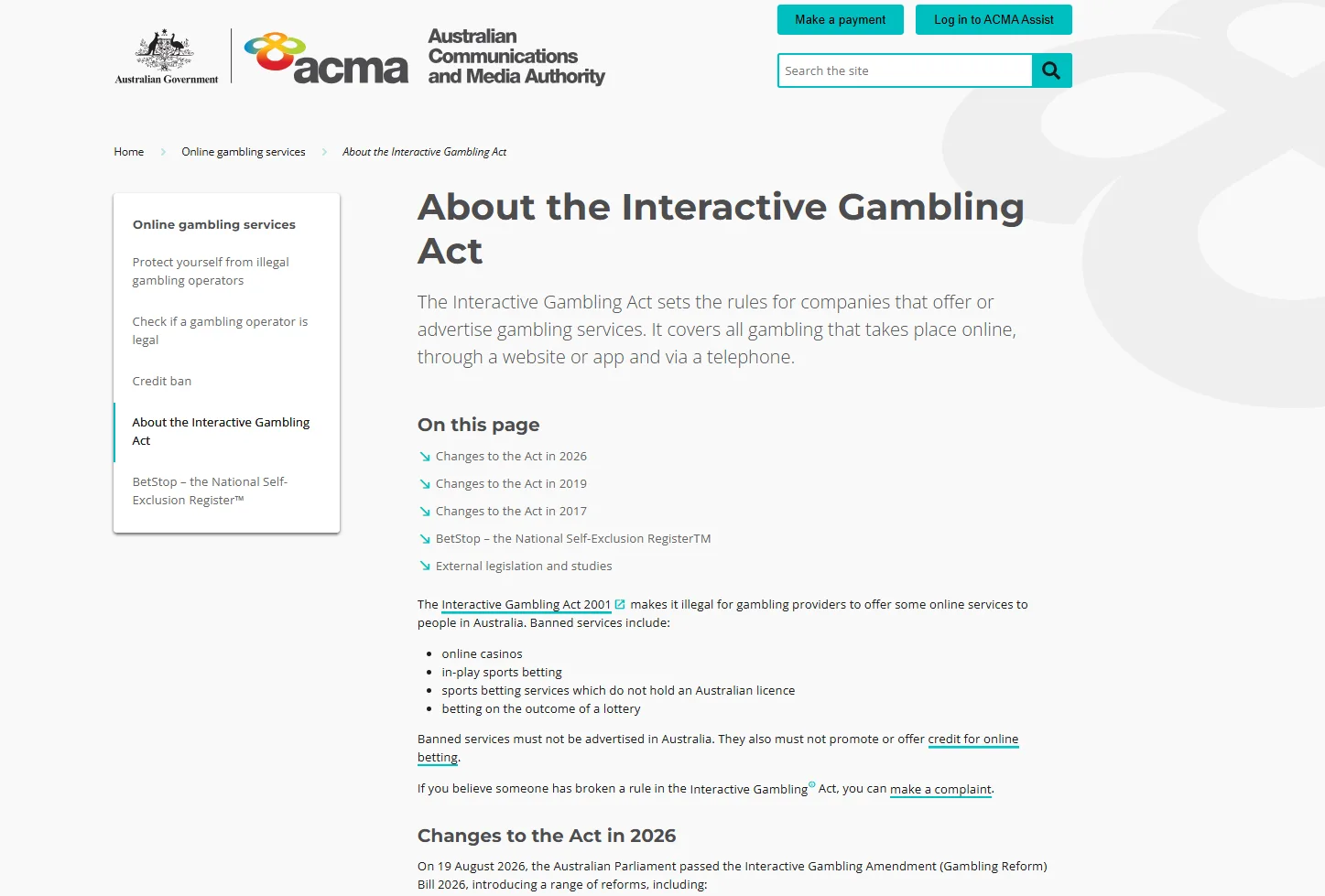
ACMA’s current interactive gambling complaint form accepts reports about prohibited gambling services. Its consumer guidance explains the risks and possible next steps when money cannot be recovered from an overseas gambling website.
Questions to ask before relying on a review
- Is the statement a first-person experience, a platform finding, or a regulator finding?
- Does the reviewer show enough transaction or game evidence to support the specific allegation?
- Is the review recent enough to reflect the current site and current terms?
- Is the same issue independently visible elsewhere, or is it a single isolated report?
- Was the complaint resolved, rejected, left unanswered or closed for lack of evidence?
- Does a positive payout comment describe one transaction, or does it actually cite an operator policy?
These questions are more useful than turning star ratings or complaint counts into a safety score. They keep the analysis tied to what the source can actually support.
Practical reading on SACINO7 complaints
The current public record contains both positive Australian payout and service comments and serious negative allegations. One structured Casino Guru complaint about an alleged uncredited win was rejected because the platform considered the evidence insufficient. The Trustpilot sample is recent but small, so it should be read as a collection of user experiences rather than a statistical measure of SACINO7’s overall performance.
The strongest approach is to preserve the distinctions: allegations are allegations, complaint-platform decisions are platform decisions, and ACMA guidance describes the Australian regulatory environment rather than deciding an individual casino dispute. For the complete brand overview, return to the full SACINO7 review; for transaction-specific issues, use the payout guide.
Written by the editors at sc7 Casino.